From time to time I describe myself as someone interested in everything. Though I’ve never regretted being this way, there is a negative side to it.
For example, though I think most followers of this website follow it because of my writing on autism (and I am 3/4 way through my upcoming book, Autism Dreaming), whenever I encounter an interesting side-trail on the road of life and the world, I have to explore it.
The universe is especially interesting at the moment because of the James Webb Space Telescope (JWST), that was launched by the ESA (European Space Agency) on Dec 25/2021 from their spaceport in French Guiana, South America.
The JWST looks much deeper into the universe than any other telescope has been able to do. But instead of confirming what the astrophysicist experts were predicting – finding a point at which there are no stars or galaxies to be seen, which would confirm their Big Bang theory since it predicts a 300 million year period following the Big Bang when no stars existed, the JWST instead is simply reporting more and more stars and galaxies.
Watching the dismay of most astrophysicists, I couldn’t help being reminded of the Large Hadron Collider (LHC) a few years ago – much of the quantum physics establishment was anticipating that it would confirm their “super-symmetry” theory, that they were so excited about, by finding particles that the theory predicted. To their dismay, the LHC found no sign of symmetry.
For the sake of keeping this post short, I’m going to try to stay away from the physics of all this, except to say that the Big Bang theory (also known as the Standard Model) was founded on the assumption that the redshift of light from distant galaxies, discovered by Edwin Hubble in the 1920s, is caused by the expansion of the universe. The redshift is the foundation block of the theory. Critics of the theory insist that the enormous distances alone might be producing the redshift in some way.
At first the Big Bang community tried to deny that the JWST was seeing galaxies, but as the JWST’s images become more detailed, they had to give that up.
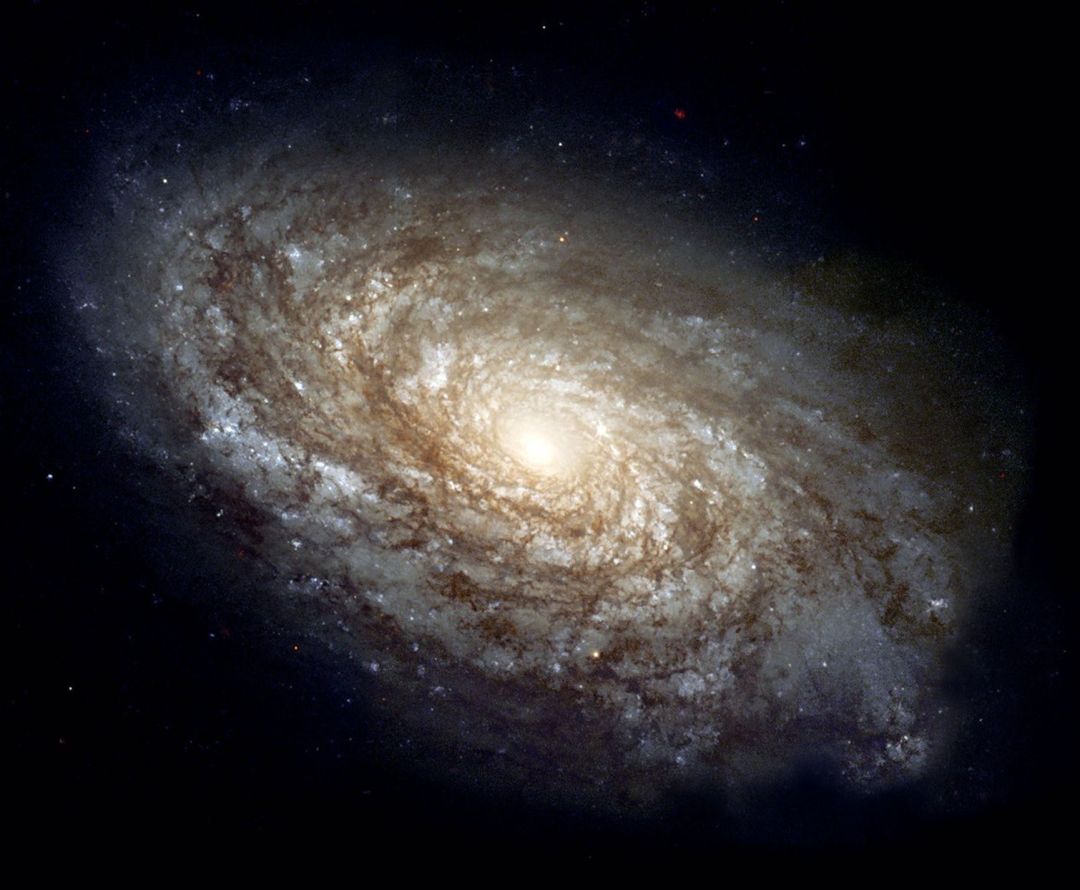
This week we learned that the JWST has revealed a new galaxy – F200DB-045 – with a redshift of 20.8. the highest yet recorded I believe, which is unquestionably a large mature spiral galaxy, like our own Milky Way, or the galaxy shown in the above photo, courtesy of NASA – NGC 4414 – said to be 60 million light-years away from us (I tried to get F200DB-045 from NASA or ESA, but they aren’t offering it yet). According to the Big Bang theory there has not been time enough to produce that galaxy.
But even before the launch of the JWST, based on findings of the Hubble telescope, the evidence was already moving away from support for the Big Bang theory. Plasma physicist Eric Lerner, an outspoken commentator on this since he published his 1992 book, The Big Bang Never Happened, describes in an article of the same name (“The Big Bang Never Happened” – August 11/2022 in IAI News), what has been happening:
….as the crisis in cosmology became obvious in 2019, the cosmological establishment has circled the wagons to protect this failed theory with censorship, because it now has no other defense. It has now become almost impossible to publish papers critical of the Big Bang in any astronomical journals.
I was a bit surprised by this desperate reaction, because I assumed that the Big Bang people would just follow their practice over the past 40 years or so, gradually increasing the time since the Big Bang to fit the evidence. If I remember right, they started at about 7 billion years, then, over a few decades, they gradually increased this until they arrived at their current estimate of 13.8 billion years. But now, for some reason, they seem to feel 13.8 is a line in the sand that must be defended.
Maybe their silence is due to the fact that, based on the JWST images, adding another 500 million years or so, as they used to do, isn’t going to do the trick. But if they suddenly declare the Big Bang to have occurred 20 billion years ago they’re credibility is going to drop rapidly.
Why is there such resistance to questioning the Big Bang? I think it’s obvious. As soon as the idea was put forward in the 1920s, the media loved it – Science finally had its own creation story. And, for some reason, people love explosions. I’m still surprised that no one has made an action movie (as far as I know), using the Big Bang. That the public as well as scientists don’t want to give up on the Big Bang is understandable, but there’s nothing scientific about this reluctance.
For over a century the Big Bang theory was repeated again and again, until those of us who grew up with it came to accept it unquestioningly. It’s time we stopped accepting it, stop pretending that this century old theory is irrefutable and realize that a full understanding of the universe is still far away.
There is so much more to say, but I’m going to stop here. I just had to get that off my chest so I can get back to writing, Autism Dreaming.
PS – If any readers want to ask about the physics here, or just want to dispute anything I’ve said, I will be happy to respond.

 Alan Conrad
Fascinating! (And no disputing…:)
LikeLike