 Besides keeping this blog, and writing my books, I do other things. One of them, for the past year or so, has been answering questions on Quora.
I didn’t go after that. But after intervening with comments on a couple of disputes, Quora invited me to be a regular in answering questions. Well, that’s proved to be a mixed blessing – there are many interesting questions, but there are far more that would be easily answered by simply doing a search, and there are some that are totally idiotic.
This week though someone asked why mules can’t reproduce, when dog/wolf crosses, etc are 100% viable. This is a subject I’ve thought about for a long time. Here was my answer:
Because mules are so strong and talented, I’ve long been suspicious of this claim that they can’t reproduce – and apparently there have been exceptions. Keep in mind that mule producers probably aren’t trying to breed them, or allowing them to attempt to breed – for a long time I’ve wished to see an experiment done where 500 or so mules, 50/50 male and female, are released in a suitable wilderness area to live unencumbered by humans for 30 yrs or so. Then we go back and see what’s happened. I would bet that the result would surprise a lot of people. I hope someone, somewhere in this world, will try it one day.
There was so much more left to say, so I’ve continued thinking about this.
Why is it, I keep asking myself, that there is such an aversion in us for hybrid? Pure bred dogs are expensive. Mixed-breed dogs [‘mongrels’] can be had for free at the humane society or other dog pounds/refuges, despite the fact that it’s well established that mixed-breeds are almost always genetically healthier.
I’m reminded again of the North American (Canada and USA) government fishery departments’ adoption of the Splake, a hybrid of lake trout and brook trout, which they began to plant in many lakes in the 1960s . Why did they like that fish so much? Because it was sterile, like mules. That gave them a fish that they could control – they could count how many they’d put in a lake, how many were caught, etc. Biological managers Loved it.
Meanwhile the fish didn’t care about our rules. A few years ago I read that a study of splake in Georgian Bay (larger than most of the world’s large lakes) had found them to be reproducing there. They’re probably reproducing in many other smaller waters that aren’t being studied.
This view that hybrids are weaker/less capable, or just unwanted, extends to humans as well. One of the arguments in the nineteenth century for ‘white’ and ‘black’ people not mixing used to be that the offspring would be weaker. In some minds, that idea has persisted through the twentieth century.
When my Afro-Caribbean wife and I road transit or walked about Toronto in the 1970s, we were stared at. Some of the stares were hostile. This should not be happening, the looks said. But a loner since I entered kindergarten as a boy, that was just ‘water off a duck’s back’ to me. But I’m heartened that today no one bats an eye at mixed couples in Toronto, where there are many now.
This prejudice was present also in the assertion by most scientists that homo sapiens and neanderthal people didn’t mix. Never mind that for a long time anthropologist Milford Wolpoff tried to draw their attention to fossils that appeared to be a combination of the two. He was dismissed as a crank – everyone knew such a cross couldn’t have happened, or, if it did, like with mules, it wouldn’t have been viable.
Then in 2010, the scientists at the Max Plank Institute in Germany blew this closed door wide open with their DNA study that showed every human living, with the exception of those of sub-Saharan origin, possesses 2-4% neanderthal genes. Shortly after, many of us were found to also have DNA from another hominid species just discovered, the denisovans.
In other words, we are not today the homo sapiens who emerged from Africa 150,000 years ago, more or less. We are a hybrid of those humans with neanderthals, denisovans, probably homo erectus, and whoever else is still to be identified.
In his 2018 book, Who we are and How we got Here, geneticist David Reich (who was a partner in the Max Plank work on neanderthal DNA) tells us that humanity has been mixing for a long time, still is, and we need to get used to it.
If you haven’t read Reich’s book, I recommend it – it’s a Pandora’s box of surprises. For example, who would have predicted that north Europeans and North American indigenous people share 20% of their DNA? Read that book and you’ll appreciate what an explosion of knowledge about ourselves is underway.
This, by the way, has been made possible by the new ability to extract DNA from ancient fossils. I hope we’ll get a report soon on the ancient DNA of horses and donkeys vs those existing today. My bet is that we’ll find there were ancient mules then too, long before humans started meddling with these animals.
If I were Bill Gates or Elon Musk, etc, the experiment I describe above – letting mules live in the wild for once like horses have so successfully done for centuries – would have been underway long ago.
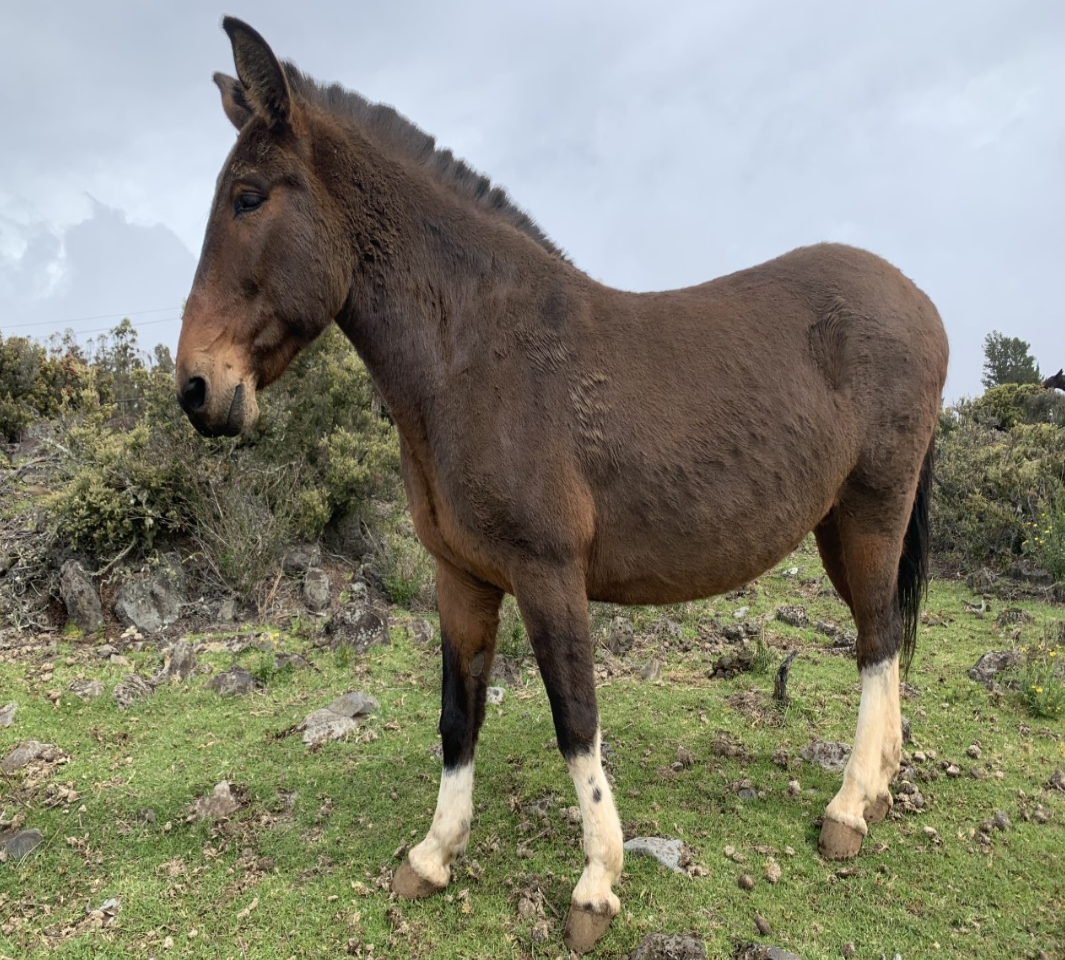
PS – the photo of the handsome mule you see above, whose name is Clyde, is courtesy of Haleakalā National Park in Hawaii. Clyde, who weighs 1300 pounds and looks like he could face down most male horses, they say loves to pose for photos. He is one of their team of mules, all of whom you can meet if you click this link:

 Alan Conrad